
Table of Contents
- What a Vehicle History Report Actually Contains
- What Is an HPI Check and How Does It Work?
- How Accurate Is a Vehicle History Report?
- Outstanding Finance: What Buyers Should Know
- Stolen Vehicle Checks: What Buyers Should Know
- Insurance Write-Off Categories Explained
- Common Mistakes When Using a Vehicle History Report
- Complementary Checks That Strengthen Your Due Diligence
- Conclusion
- Frequently Asked Questions
Last Updated: 30 August 2026
A vehicle history report is one of the most useful tools available when buying a used car, but it is important to understand exactly what a report can — and cannot — tell you.
HPI Check Scotland has produced this guide to explain how vehicle-history information works, why the underlying data matters, where limitations can arise and how buyers can use a report alongside their own checks to make a better-informed decision.
The best answer to the question "Is a vehicle history report accurate?" is that a good report provides a valuable picture of the information available through the relevant data services at the time of the check.
That is not the same as saying that a database can know everything that has ever happened to a vehicle.
Understanding that distinction makes a vehicle history report more useful, not less.
What a Vehicle History Report Actually Contains
A vehicle history report brings together information returned from a number of vehicle-data services and presents it against a vehicle registration number (VRM), Vehicle Identification Number (VIN), or both.
Depending on the report type, the vehicle and the information available, a history check may include:
- Outstanding finance: whether relevant finance information has been returned against the vehicle
- Insurance write-off history: whether a recorded insurance total-loss category has been returned
- Stolen vehicle information: whether a stolen-vehicle marker has been returned through the relevant data service
- Mileage history: recorded odometer readings from MOT tests and other available sources, which can help identify inconsistencies
- MOT history: previous tests, results, recorded mileage, defects and advisories where available
- Road tax and registration information
- Keeper and registration history where available
- Vehicle specifications and identity information
- Other history information where supplied for that vehicle
A vehicle-history report should be treated as a way of checking the information available through those services at the time of the enquiry.
It cannot independently reveal an event that has not yet been recorded, supplied or made available through the relevant data systems.
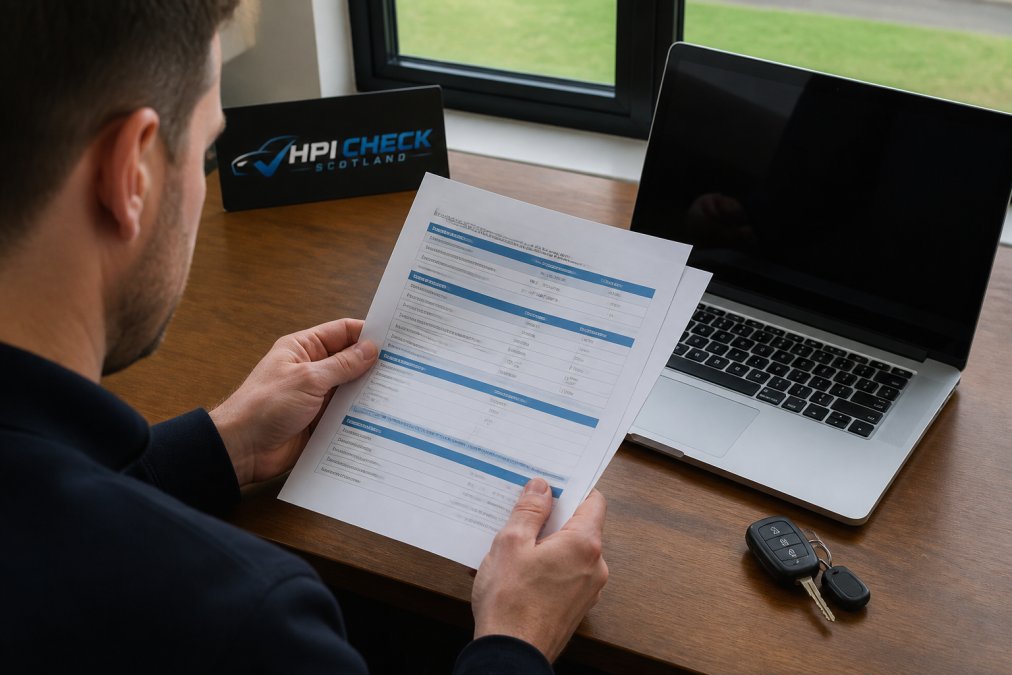
Pro Tip
Always compare the registration number and VIN shown in the report with the physical vehicle and its V5C. A history report is only useful if the identifiers being checked genuinely belong to the vehicle in front of you.
What Is an HPI Check and How Does It Work?
The term "HPI check" is widely used by motorists as shorthand for a vehicle history check, although HPI is also the name of a separate commercial vehicle-history provider.
HPI Check Scotland is an independent vehicle-history check service and is not part of or affiliated with HPI Ltd.
When a customer carries out a check with HPI Check Scotland, vehicle-history information supplied through our commercial data services is brought together and presented in an easy-to-read report.
The exact information available depends on the report selected, the particular vehicle and the data returned at the time of the enquiry.
Official information also forms part of the wider vehicle-data landscape. For example, the Driver and Vehicle Standards Agency (DVSA) provides an official MOT History API giving authorised users access to vehicle and MOT-test information.
For motor trade customers carrying out multiple checks, trade vehicle history checks and bundle options are also available.
A vehicle-history report does not replace checking the physical vehicle, its documentation or the person selling it. Those checks answer different questions.
How Accurate Is a Vehicle History Report?
A vehicle-history report is a snapshot of information returned by the data services used at the time of the check. Its accuracy therefore depends on the underlying records, the vehicle identifiers being checked and the information available at that moment.
There is an important distinction between:
"No adverse information was returned."
and:
"This vehicle has never had an adverse event."
A database-driven report can tell you the first. It cannot always prove the second.
Why Data Sources and Reporting Delays Matter
Vehicle-history information depends on real-world events being recorded and then becoming available through the relevant data systems.
Information about finance, stolen status or an insurance write-off may pass through different organisations and systems before it becomes available through a commercial vehicle-data service. The precise update process and timing can differ between data sources.
A very recent event may therefore not yet be available when a vehicle check is carried out.
The reverse can also happen. Information that has recently changed — for example, a finance agreement that has just been settled — may take time to be reflected by the relevant data systems.
This is why a vehicle-history report should describe what the available data shows at the time of the check rather than being treated as proof that no unrecorded or not-yet-available event exists.
What a Clear Result Really Means
A report showing no outstanding finance, no stolen marker and no recorded insurance write-off is a positive result.
It means that no adverse information of that type was returned by the relevant data services used for the check.
It does not mean that a database can see something that:
- has never been reported
- has not yet reached the relevant data source
- has not yet become available through the service being queried
- relates to a different or falsified vehicle identity
A clear vehicle-history report improves the information available to a buyer, but it should still be considered alongside the physical vehicle, its VIN, V5C, seller and other evidence.
Watch Out
"No adverse information returned" is not the same as guaranteeing that no adverse event has ever occurred. A vehicle-history report checks recorded information; it cannot see an event that has not yet reached the relevant data systems.
Outstanding Finance: What Buyers Should Know
Outstanding finance is one of the most important areas to investigate before buying a used vehicle.
Under hire purchase and conditional-sale arrangements, the person using the vehicle may not yet own it outright and will normally need the lender's permission before selling it.
However, the legal position for an innocent private purchaser is more nuanced than simply saying that a finance company can always repossess the vehicle.
Under section 27 of the Hire-Purchase Act 1964, a private purchaser who buys a motor vehicle in good faith and without notice of a qualifying hire-purchase or conditional-sale agreement can, in certain circumstances, obtain good title to the vehicle.
Citizens Advice Scotland explains that a private buyer may have the right to keep the vehicle where the relevant good-title conditions are met.
Citizens Advice also explains that, where the position is disputed, it is for the finance company to establish that the purchaser does not have good title rather than for the purchaser to prove that they do.
The type of finance, the circumstances of the transaction, whether the purchaser is buying privately and the chain of ownership can all matter. Anyone involved in an actual ownership dispute should obtain appropriate advice.
A vehicle-history check remains an important precaution because it can alert a prospective buyer to finance information returned before money changes hands.
If a report shows outstanding finance, do not simply rely on an assurance from the seller that it has been paid.
Before proceeding:
- Ask the seller for evidence explaining the finance position.
- Where possible, confirm the position with the relevant finance provider.
- Do not complete the purchase until you are satisfied that the finance issue has been resolved.
The safest time to investigate finance is before purchasing the vehicle, not after an ownership dispute begins.
Stolen Vehicle Checks: What Buyers Should Know
Stolen-vehicle information is another important part of a used-car history check.
A history report can return a stolen marker only when relevant stolen-vehicle information is available through the data service used for that enquiry.
Timing therefore matters.
A very recent theft or report may not yet have become available through every relevant system or commercial data service when a vehicle-history report is generated.
A clear stolen-vehicle result should therefore be understood as:
No stolen marker was returned by the relevant data service at the time of the check.
It should not be interpreted as a promise that a vehicle could not have been stolen very recently if that information had not yet become available through the relevant systems.
Vehicle identity matters as well.
Buyers should compare the VIN, registration plates, V5C and physical vehicle carefully. A history report run against a genuine registration number cannot reveal the true history of a different vehicle carrying a cloned or falsified identity.
If a stolen marker is returned, do not proceed with the purchase until the position has been properly investigated.
Insurance Write-Off Categories Explained
An insurance write-off is a vehicle that an insurer has treated as a total loss.
Some write-off categories cannot return to the road. Others may be repaired and used again provided they are restored to a roadworthy condition.
Category A — Cannot return to the road
The vehicle cannot be repaired and the entire vehicle must be crushed.
Category B — Cannot return to the road
The vehicle cannot be repaired and the body shell must be crushed, although other parts may be salvaged.
Category S — Structural damage; repairable
The vehicle has suffered structural damage. It can return to the road if repaired to a roadworthy condition.
Category N — Non-structural damage; repairable
The vehicle has suffered non-structural damage. It can return to the road if repaired to a roadworthy condition.
What Happened to Category C and Category D?
Older vehicle records may still show Category C or Category D.
The insurance salvage classification system changed on 1 October 2017, when Category C and Category D were replaced by the current Category S and Category N system.
- Category C used the older economic repair classification and should not be treated as a direct equivalent of Category S
- Category D used the older economic repair classification and should not be treated as a direct equivalent of Category N
However, they are not exact one-for-one renames. The older C and D system placed greater emphasis on the economics of repairing the vehicle, while the current S and N classifications distinguish whether the recorded damage is structural or non-structural.
That means an older history showing Category C or D is not an error simply because the current system uses S and N. It reflects the classification system in use when that write-off was recorded.
The GOV.UK guidance on insurance write-offs explains the current A, B, S and N categories.
Category A and B vehicles cannot return to ordinary road use.
Category S and N vehicles can return to the road following suitable repair, but the category alone does not tell you whether those repairs were carried out well.
A buyer considering a Category S or Category N vehicle should investigate the previous damage, available repair history and present condition carefully.
An independent inspection may be sensible, particularly where structural damage has previously been recorded.
Key Takeaway
A write-off marker tells you important recorded history about the vehicle. It does not inspect the quality of any repair that happened afterwards.
Common Mistakes When Using a Vehicle History Report
The usefulness of a vehicle-history report also depends on how the buyer interprets it.
Checking the wrong vehicle. Entering an incorrect registration number could return information for a different vehicle or no matching result. A cloned or falsely identified vehicle creates a similar problem. Compare the VRM and VIN carefully.
Treating "nothing returned" as "nothing ever happened." A clear result means the relevant check did not return adverse information at that time. It cannot reveal an event that has never been recorded or is not yet available through the relevant data source.
Ignoring mileage inconsistencies. Recorded mileage should be considered chronologically. Unexpected reductions or unusual changes deserve investigation, but a single strange entry is not automatically proof of clocking. Recording errors, odometer replacement and kilometres-versus-miles issues can also produce unusual readings.
Treating the V5C as proof of ownership. The V5C identifies the registered keeper. The registered keeper is not necessarily the legal owner. Use the V5C as an important identity and registration document, but also satisfy yourself that the seller is entitled to sell the vehicle.
Treating a history report as a mechanical inspection. A database cannot tell you whether a gearbox is about to fail, whether an old repair was completed properly or whether an accident occurred but was never reported. A vehicle's recorded history and its current physical condition are separate things.
Ignoring an inconsistency because the rest of the report is clear. If the VIN, registration, specification, mileage, finance position or other information does not make sense, investigate the discrepancy before buying rather than assuming it is harmless.
Complementary Checks That Strengthen Your Due Diligence
A vehicle-history report is most useful when combined with checks that databases cannot perform for you.
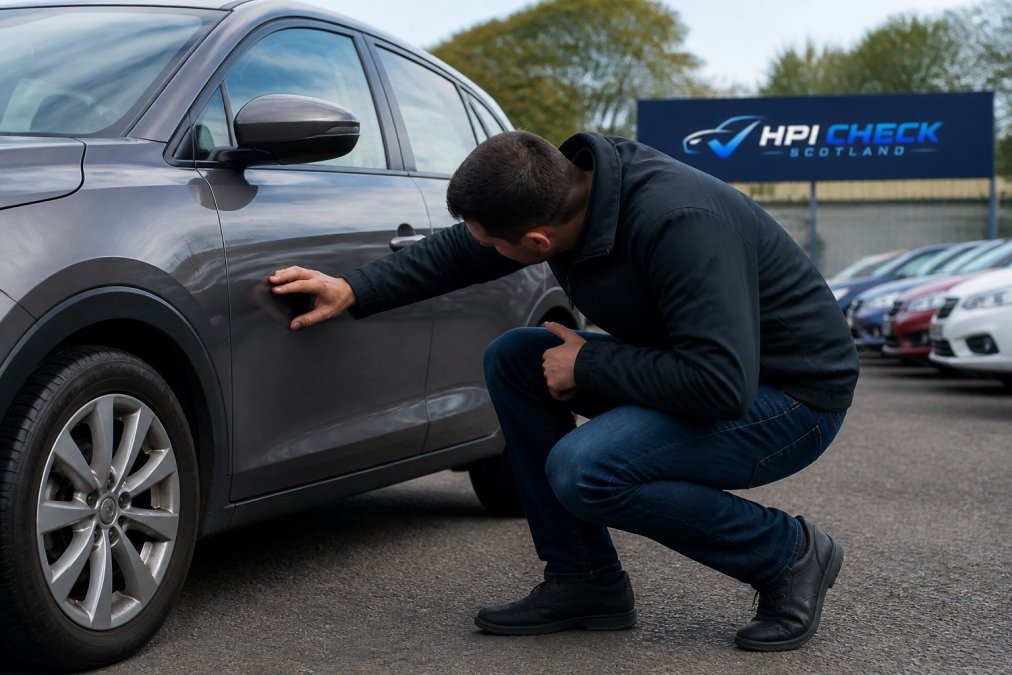 Inspect the vehicle. Look for inconsistent paintwork, unusual panel alignment, corrosion, damage and evidence of previous repair.
Consider an independent inspection. For a significant purchase, a suitably qualified mechanic or vehicle inspector can assess areas that no history database can determine.
Test drive the vehicle. Check that the vehicle drives, brakes and operates as expected.
Check the V5C and VIN. Compare the registration number, VIN and vehicle details with the physical vehicle, the documentation and the history report.
Check the seller. Satisfy yourself that the person selling the vehicle is entitled to do so. The person named as registered keeper on the V5C is not necessarily the legal owner.
Keep useful evidence. Retaining the advert, receipt, payment evidence and relevant correspondence can be useful if a problem later develops.
None of these steps replaces a vehicle-history report, and a vehicle-history report does not replace them.
They answer different questions.
Conclusion
So, is a vehicle history report accurate?
The best answer is that a good vehicle-history report provides a valuable picture of the information available through the relevant data services at the time the check is carried out.
It can identify important recorded risks such as outstanding finance, stolen-vehicle information, insurance write-offs, mileage inconsistencies and other vehicle-history information.
What it cannot do is make an event appear before that event has been recorded and made available through the relevant data systems, prove that a seller is telling the truth, or assess the physical condition of the vehicle.
That is not a reason to avoid carrying out a vehicle-history check.
It is a reason to understand exactly what the check does.
Use the report to investigate the vehicle's recorded history, then compare that information with the vehicle itself, its documentation and the seller before making your decision.
A few minutes spent checking properly before buying can reveal important information that would otherwise be impossible to see from an advert, a test drive or the vehicle's appearance alone.
Frequently Asked Questions
Can a vehicle history report be wrong?
A vehicle-history report can contain gaps or information that later changes. Reports depend on information being recorded and made available through the data services used for the check.
A very recent event, an unreported incident or an incorrect source record may therefore affect what is returned.
A clear result should be treated as an important part of your buying checks rather than proof that no adverse event has ever occurred.
What information can a vehicle history check include?
Depending on the report type, vehicle and available data, a history check may include outstanding finance, stolen-vehicle information, insurance write-off history, mileage records, MOT information, registration history, keeper information, vehicle specifications and other relevant vehicle-history data.
The exact information available can differ between vehicles and report types.
What should I do if I believe an HPI Check Scotland report contains incorrect information?
Contact HPI Check Scotland with the vehicle registration, report details and an explanation of the information you believe is incorrect.
We can review the information returned for the report and help identify what may need further investigation.
Where the underlying information belongs to another organisation — for example a finance provider or an official record — correction may ultimately need to be made by the organisation responsible for that source data.
Keep copies of relevant documentation and correspondence.
Does a clear vehicle history report mean the car is definitely problem-free?
No.
A clear result means that the relevant checks did not return adverse information at the time of the enquiry.
A vehicle-history report cannot inspect the car, verify everything a seller tells you, or reveal an event that has not yet been recorded or made available through the relevant data systems.
Use the report alongside checks of the vehicle, VIN, V5C, seller and physical condition.